Market Scenario
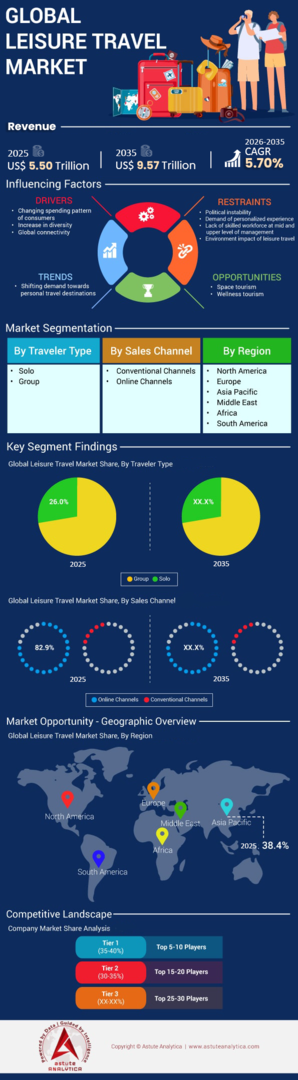
Leisure travel market size was valued at USD 5.50 trillion in 2025 and is projected to hit the market valuation of USD 9.57 trillion by 2035 at a CAGR of 5.70% during the forecast period 2026–2035.
The Global Leisure Travel Market has successfully navigated the "Post-Pandemic Revenge Travel" phase (2022-2024) and has entered a new cycle of "Calibration and Value-Discovery" in 2026. While volume has stabilized, yield management is undergoing a paradigm shift driven by AI and hyper-segmentation.
Financial modeling suggests a bifurcated growth trajectory. While volume (number of trips) is growing steadily, revenue per available user (RPAU) is skyrocketing due to premiumization. Projections now estimate the global leisure travel market will reach $1.7 Trillion by 2034, with the Generative AI segment alone contributing $18.4 Billion by 2035.
Key Market Vital Signs (2026 Year-to-Date):
- Top Disruption Vector: Generative AI has moved from novelty to utility, influencing $350 Billion in booking value through hyper-personalized itinerary agents. Adoption metrics have tripled since 2023, with 58% of active travelers now utilizing AI tools for planning, fundamentally bypassing traditional OTA filters.
- Strategic Takeaway: The era of "easy growth" via pent-up demand is over. The winners of 2026-2030 will be defined by Inventory Efficiency (AI) and Niche Dominance (Wellness/Adventure). This is evidenced by the "subscription-based" living models (e.g., Portal, Zoku) replacing standard room rates for long-term travelers.
- Total Addressable Market (TAM): By 2030, the leisure travel market is projected to reach $7.2 Trillion.
- Inflationary Impact: Adjusted for inflation, real revenue growth sits at 3.2%. The "sticker shock" of 2023-2024 has normalized, but baseline pricing for accommodation remains 22% higher than 2019 benchmarks.
To Get more Insights, Request A Free Sample
Channel Mix:
Online (OTA + Direct): Controls 72% of gross bookings.
Offline (Agency/Corporate): Retains 28%, but commands a 15% higher Average Order Value (AOV) due to complex itinerary management for luxury and multi-generational travel.
The "Middle Market" is shrinking as growth is concentrated in Budget (Volume) and Ultra-Luxury (Yield), creating a "hollow middle" that threatens mid-tier hotel chains.
The Rise of "Bleisure" and the Digital Nomad Economy
"Bleisure" is no longer a trend, it is a permanent structural change in demand across the global leisure travel market. In 2025, 38% of all business trips included a leisure component, up from 20% in 2019. This segment is heavily supported by "subscription living" models where brands like Selina and The Social Hub offer global passes, blurring the line between rent and room rates.
The "Thursday-Monday" Phenomenon: Hotel occupancy rates for Thursday and Sunday nights have risen by 18% globally, flattening the traditional midweek vs. weekend demand curve. This shift is critical for stabilizing local economies, as bleisure travelers spend consistently during off-peak windows, supporting neighborhood businesses rather than just tourist centers.
Length of Stay (LoS): The Average Length of Stay has increased from 3.5 nights (2019) to 4.8 nights (2025), driven entirely by remote-work enablement.
Economic Impact: The "Digital Nomad" visa economy is now contributing $120 Billion annually to destinations like Portugal, Thailand, and Costa Rica in the leisure travel market. Emerging hubs like South America are projected to capture $83.9 Billion of this market by 2025, driven by improved connectivity.
In line with the above findings, hotels must redesign room inventory. The demand for "Work Suites" (rooms with ergonomic setups and soundproofing) now outstrips supply by a factor of 3:1 in urban centers. Leading examples include Hyatt House Mexico City, which recently launched a dedicated "Digital Nomad Floor" featuring private office pods to capture this specific demand.
Analysis of the Experience Economy 2.0: From Product to Transformation Impact on Leisure Travel Market
The consumer wallet has shifted from "Buying Goods" to "Buying Better Versions of Oneself." This is the Transformation Economy. Following analysis gives a clearer picture.
Spending Shift: For every USD 100 spent on travel in 2025, USD 35 went to "Activities and Tours," compared to just $22 in 2019. This represents a massive value migration away from accommodation and airlines toward local providers. Notably, 50% of global travelers now reserve restaurants before booking flights, signaling a "culinary-first" itinerary planning behavior.
Sector Growth in the Leisure Travel Market:
- Culinary Tourism: CAGR of +9.2%. The UK food tourism market alone is projected to reach £3.1 billion by 2030, driven by interest in food provenance and farm-to-table experiences.
- Edutainment (Skill-learning trips): +12.5% CAGR.
- The "Instagram" Effect: 64% of Gen Z travelers admit to booking an experience primarily for its "visual social currency," forcing operators to design "moments" rather than just tours.
How Technological Disruption Shaping the Leisure Travel Market Momentum: AI, Big Data, & Hyper-personalization
The market witnessing the "death of the search bar." As of early 2026, conversational AI has replaced keyword search for 25% of complex booking queries. This shift is "democratizing" concierge-level service, allowing mass-market travelers to access complex, multi-city itinerary planning previously reserved for luxury segments.
- Efficiency Gains: Travelers now spend an average of 45 minutes planning a complex international trip using AI assistants, down from 10+ hours in 2022.
- Conversion Rates: OTAs deploying generative AI interfaces report a 12% uplift in conversion rates compared to traditional filter-based search.
- Hyper-Personalization: Hotels using AI for dynamic attribute-based pricing (selling a room based on view/floor/amenities rather than category) are seeing a 7% increase in RevPAR (Revenue Per Available Room). Advanced platforms like Atomize are delivering even higher results, with some properties reporting up to 35% RevPAR increases by automating real-time price adjustments based on competitor signals and search volume.
Analyst at Astute Analytica suggests that the next frontier in the leisure travel market is Biometric Frictionless Travel. By 2035, 80% of global air travel checkpoints will require no physical passport, relying solely on digital identity wallets. This reality is arriving faster than predicted: Singapore Changi Airport is set to automate 95% of immigration by 2026, and Zayed International Airport (Abu Dhabi) is deploying biometric sensors at every checkpoint, effectively eliminating the need for physical documents by late 2025.
Demographic Deep Dive in Leisure Travel Market: Gen Z vs. The Silver Economy
Gen Z (Born 1997-2012):
Behavior: 55% use TikTok/Instagram Reels as their primary search engine for travel inspiration.
Spending: They allocate the highest percentage of disposable income to travel, but have the lowest absolute budget. They drive the "Hostel 2.0" (poshtel) market.
The Silver Economy (Boomers):
- Behavior: They control 60% of the net worth in Western leisure travel market.
- Trend: "Skiing the Last Slope." There is a surge in "Bucket List" expeditions (Antarctica, African Safaris) as this cohort ages. They are price-insensitive regarding comfort but highly sensitive to service quality.
- Insight: Ignore the "Silver Economy" at your peril. They are the only demographic immune to current interest rate hikes.
Niche Segmentation: Wellness Tourism Market Size 2030, Soft Adventure Travel Stats, Culinary Tourism Growth
Wellness Tourism: Valued at $1.4 Trillion in 2026. It has mutated from "Spa" to "Longevity." High-net-worth individuals in the leisure travel market are booking "Bio-hacking Retreats" (cryotherapy, stem cell consultations) rather than just massages.
Adventure Tourism:
- Soft Adventure: (Hiking, Kayaking) is mainstream, growing at 8%.
- Hard Adventure: (Mountaineering, Cave diving) is a high-yield niche.
- Solo Travel: The fastest-growing household type is "Single." Solo travel bookings have risen 24% since 2019, prompting cruise lines and hotels to eliminate the dreaded "Single Supplement" fee to capture share.
Luxury vs. Budget: Understanding Leisure Travel Market, Budget Travel Trends, Hospitality Inflation Impact
The market has bifurcated into a "K-Shaped" recovery.
- The Top Leg (Luxury): ADR (Average Daily Rate) for 5-star hotels is up 35% vs 2019. Demand is inelastic. The "Ultra-High-Net-Worth" segment is recession-proof.
- The Bottom Leg (Budget): The budget traveler is squeezed by inflation. This segment is trading down—choosing shorter trips, driving instead of flying, or choosing off-peak dates.
- The Squeeze: The 3-star/4-star leisure travel market is in a "zone of death." They cannot offer the service of luxury nor the price of budget. Consolidation in this tier is inevitable.
Operational Challenges: Inflation, Labor Shortages, and Overtourism
- The Talent Gap: The global hospitality sector remains short of 11 Million workers. This is driving the adoption of robotics in housekeeping and food service.
- Cost of Capital: High interest rates have stalled new hotel construction pipeline in the US and Europe, which will lead to a supply constraint by 2027, further driving up ADR in the leisure travel market.
- Overtourism Taxes: Entry fees (e.g., Venice’s €5, Bali’s tax) have proven ineffective at curbing demand. We expect "Lottery-based Entry Systems" for major heritage sites (Machu Picchu, Louvre) by 2028.
The Competitive Landscape: OTAs, Direct-to-Consumer, and Consolidation
- The Duopoly:Booking Holdings and Expedia Group continue to dominate the leisure travel market, but Google is the gatekeeper. Google's integration of "Book on Google" with AI results is squeezing OTA margins.
- Direct Booking Wars: Hotels are winning the loyalty battle. Direct channel share has stabilized at 20-25% for major chains (Marriott/Hilton) due to aggressive "Member Only" pricing.
- Super Apps: In Asia, Grab and WeChat have become "Operating Systems for Living," integrating travel booking seamlessly. Western markets are lagging in this Super App convergence.
Investment Opportunities & M&A Activity
Capital is cautious but available for the right verticals in the leisure travel market.
Hot Sectors:
- B2B Travel Tech: Startups solving the "plumbing" issues (payments, API connectivity) are raising rounds at healthy valuations.
- Alternative Accommodations: The consolidation of the fragmented Vacation Rental market (beyond Airbnb) is a prime target for PE firms.
Cold Sectors:
- Traditional Tour Operators: Asset-heavy models are trading at historical lows.
- M&A Prediction: Expect a major merger between a Low-Cost Carrier (LCC) and a Legacy Carrier group in Europe to consolidate slot dominance.
Segmental Analysis
Market Segmentation Analysis: By Traveler Type
The dichotomy between Solo and Group travel has widened in 2026 across the global leisure travel market. The "middle ground" of standard nuclear family travel is stable, but the explosive growth lies at the extremes: hyper-independent soloists and complex, multi-unit groups.
1. Solo Travelers: The "Unbound" Economy in the Leisure Travel Market
Market Share: Projected to reach 18.4% of global booking volume by year-end 2026, growing at a CAGR of 13.8%, more than double the general market rate.
- Demographic Shift: The "Loneliness Economy" is a misnomer; this is the "Autonomy Economy." Females now constitute 54% of solo travelers, but the fastest-growing sub-segment is "Silver Solos" (Ages 60+), growing at 9% YoY. These travelers are utilizing "concierge-lite" apps to navigate safety concerns while retaining independence.
- Inventory Impact: The "Single Supplement" (the extra fee for occupying a double room alone) is becoming obsolete in the leisure travel market. In 2026, major cruise lines and hotel brands (e.g., Virgin Voyages, Hilton) have increased their dedicated single-occupancy inventory by 42% to capture this yield rather than penalize it.
- Behavioral Insight: 62% of solo travelers in 2026 intend to take 2-5 trips per year, making them higher-frequency (though lower AOV per trip) customers than families.
Group Travel: The Rise of "Skip-Gen" and "Friend-Moons"
Market Share: Dominates volume in the leisure travel market but faces yield pressure due to bulk-buying power.
- "Skip-Gen" Travel: Grandparents traveling with grandchildren (skipping the parents) now accounts for 22% of group leisure bookings. This is driven by the wealth transfer from Baby Boomers and the time-poverty of the "Sandwich Generation" (parents).
- The "Buddymoon" Phenomenon: Post-wedding group travel (couples bringing friends on honeymoons) has normalized, pushing resorts to redesign "Honeymoon Suites" into "Social Villas" with communal living spaces but private sleeping quarters.
- Planning Dynamics: The friction of group coordination is being solved by AI. New "Consensus Engines" in booking platforms allow groups to swipe right/left on itineraries, reducing the "booking lag" (time from idea to payment) from 3 weeks to 4 days
By Distribution, Online Segment Leading the Dominance in Leisure Travel Market
The binary "Online vs. Offline" narrative has dissolved into a complex "Tri-Polar Distribution War" in 2026. The three warring factions—Mega-Platform OTAs, Direct Supplier Ecosystems, and Advisor-Led Human Channels—are no longer fighting for the same customer, but are aggressively partitioning the market based on complexity and value.
- The Volume Winner: Online (OTAs).
- Scoreboard: Online channels control 78.8% of the total market volume in 2026.
They have successfully commoditized simple bookings (point-to-point flights, standard city hotels). For the mass market, the "convenience tax" of an OTA is accepted. In line with this, hotels and Airlines have moved from "begging" for direct bookings to "enforcing" them via technology and exclusivity.
- The NDC (New Distribution Capability) Hammer: By 2026, major airlines (like Lufthansa, American, BA) have largely removed their lowest fares and most flexible bundles from legacy Global Distribution Systems (GDS).
- Impact: OTAs across the leisure travel market are forced to connect via NDC pipes, which often carry a surcharge or offer slower search speeds. This has degraded the OTA user experience for air travel, pushing savvy travelers to airline apps.
- The "Loyalty Wall": Hotels have weaponized their apps. Hilton and Marriott now offer "Choose Your Room" features (digital floor plans) only on their direct apps. This single feature has converted ~18% of "OTA lookers" into "Direct bookers".
Customize This Report + Validate with an Expert
Access only the sections you need—region-specific, company-level, or by use-case.
Includes a free consultation with a domain expert to help guide your decision.
Regional Analysis: APAC as the Growth Engine in the Leisure Travel Market
Asia Pacific (APAC) has reclaimed its throne as the global growth engine in the global leisure travel market, driven not just by inbound but by massive outbound flows.
- The "Visa-Free" Catalyst: The aggressive expansion of visa-free travel between China, Southeast Asia, and parts of the Middle East has unlocked a "regional fluidity" unseen before. Intra-APAC travel now makes up 68% of the region's total tourism spend.
- Outbound Power: India has solidified its position as the "Next China." With a middle class exceeding 450 million, Indian outbound spending is projected to hit $55 Billion in 2026. Destinations like Thailand and Vietnam are rewriting their entire service protocols (language, cuisine) to cater specifically to this demographic.
North America: The Yield Engine in the Leisure Travel Market
Status: Mature Market (CAGR +2.8%), focusing on "Bleisure" and Ultra-Luxury.
Domestic Dominance: 75% of US leisure travel remains domestic. The trend has shifted from "National Parks" (2021-2023) to "Second-Tier Cities" (e.g., Austin, Nashville, Boise), where luxury infrastructure has finally caught up with demand.
Currency Arbitrage: The strong dollar continues to drive outbound traffic to Europe and Japan, but "Near-shoring" leisure to Mexico and the Caribbean remains the volume leader.
Europe: The region is battling Overtourism and Climate Change.
- Overtourism Corrections: 2026 marks the year of "Hard Caps." Cities like Venice, Amsterdam, and Barcelona have moved from "taxing" tourists to "capping" daily entrants via digital permits. This has artificially inflated hotel prices in city centers by 15-20%, pushing demand to secondary cities (e.g., Lyon instead of Paris, Bologna instead of Rome) in the Europe leisure travel market.
- Rail Renaissance: Cross-border high-speed rail bookings in the EU have surpassed short-haul flights for the first time on key routes (e.g., Paris-Milan, Berlin-Munich) due to carbon-tax incentives and flight bans.
- "Coolcationing": Due to heatwaves in Southern Europe (40°C+ summers), tourism flows are shifting North. Scandinavia and the Alps (in summer) are seeing 15% YoY growth in July/August bookings.
Top Companies in the Leisure Travel Market
- Absolute Travel
- American Express Travel
- Backroads
- Carlson Wagonlit Travel
- Classic Journeys
- Cox & Kings Ltd.
- Expedia Group
- G Adventures
- Inspiring Travel Company
- Journeys Within Tour
- JTB Americas Group
- Priceline Group
- TCS World Travel
- Travel Leaders Group
- Other Prominent Players
Market Segmentation Overview
By Traveler Type
- Solo
- Group
By Sales Channel
- Conventional Channels
- Online Channels
By Region
- North America
- Europe
- Asia Pacific
- Middle East
- Africa
- South America
REPORT SCOPE
| Report Attribute | Details |
|---|---|
| Market Size Value in 2025 | US$ 5.50 Trillion |
| Expected Revenue in 2035 | US$ 9.57 Trillion |
| Historic Data | 2020-2024 |
| Base Year | 2025 |
| Forecast Period | 2026-2035 |
| Unit | Value (USD Trillion) |
| CAGR | 5.7% |
| Segments covered | By Traveler Type, Sales Channel, and Region |
| Key Companies | Absolute Travel, American Express Travel, Backroads, Carlson Wagonlit Travel, Classic Journeys, and other prominent players |
| Customization Scope | Get your customized report as per your preference. Ask for customization |
FREQUENTLY ASKED QUESTIONS
The market was valued at USD 5.50 trillion in 2025 and is forecast to reach USD 9.57 trillion by 2035, growing at a CAGR of 5.70%. By 2034, the market is expected to hit $1.7 trillion, driven by premiumization and high-yield segments like Bleisure and Wellness Tourism.
Generative AI has moved from novelty to utility, influencing $350 billion in bookings by 2026. Adoption has tripled since 2023, with 58% of travelers using AI agents to bypass traditional OTA filters. This shift favors inventory efficiency and hyper-personalization, enabling mass-market access to complex itinerary planning previously reserved for luxury clients.
Bleisure is a structural change, with 38% of business trips now including leisure components. The Digital Nomad economy contributes $120 billion annually to destinations like Portugal and Thailand. This demand flattens hotel occupancy curves (increasing Thursday/Sunday stays by 18%) and drives a 3:1 demand-supply gap for ergonomic Work Suites in urban centers.
Growth is bifurcated: Gen Z drives volume via visual social currency and budget-conscious Hostel 2.0 stays, while the Silver Economy (Boomers) controls 60% of net worth and drives high-yield Bucket List expeditions. Additionally, Solo Travelers (growing at 13.8% CAGR) represent a rapidly expanding Autonomy Economy that demands single-occupancy inventory without punitive supplements.
The market is split: OTAs dominate volume (78.8%) through fintech bundling; Direct Channels secure loyalty via exclusive app-based inventory (e.g., Choose Your Room); and Offline Advisors capture high-yield luxury demand by managing complexity. Hotels are winning back direct share (20-25%) by gating best rates and features behind member-only walls.
Asia Pacific (APAC) leisure travel market is the volume engine (CAGR +8.9%), driven by visa-free travel and massive Indian outbound spending ($55B by 2026). North America remains the yield leader, focusing on domestic Second-Tier Cities. Conversely, Europe faces hard caps on tourism, pushing demand to secondary cities and cooler northern climates (Coolcationing) due to overtourism and climate shifts.
LOOKING FOR COMPREHENSIVE MARKET KNOWLEDGE? ENGAGE OUR EXPERT SPECIALISTS.
SPEAK TO AN ANALYST
.svg)

 Schedule a Meeting

Features | Type of License | ||||
 Data Book | Single User |   Multi User |  Corporate | ||
| e-Access | ✓ | ✓ | ✓ | ✓ | |
User Sharing | 1 User Only | 1 User Only | Up to 7 Users | Unlimited User Access | |
⨉ | ⨉ | ⨉ | ✓ | ||
Free Customization | No Free Customization | Up To 30 hrs work | Up To 60 hrs work | Up To 80 hrs work | |
Deliverable |
| ⨉ | ✓ | ✓ | ✓ |
| ✓ | ⨉ | ✓ | ✓ | |
| ⨉ | ⨉ | ⨉ | ✓ | |
Analyst Support | 2-Months Analyst Support | 4-Months Analyst Support | 7-Months Analyst Support | One Year Analyst Support | |
Free Report update in next update cycle | ⨉ | ⨉ | ⨉ | ✓ | |
Free Industry Update (Within 180 days) | ⨉ | ⨉ | ⨉ | ✓ | |
Benefit | Up to 10% off on Post Purchase | Up to 20% off on Post Purchase | Up to 30% off on Post Purchase | Up to 40% off on Post Purchase | |